
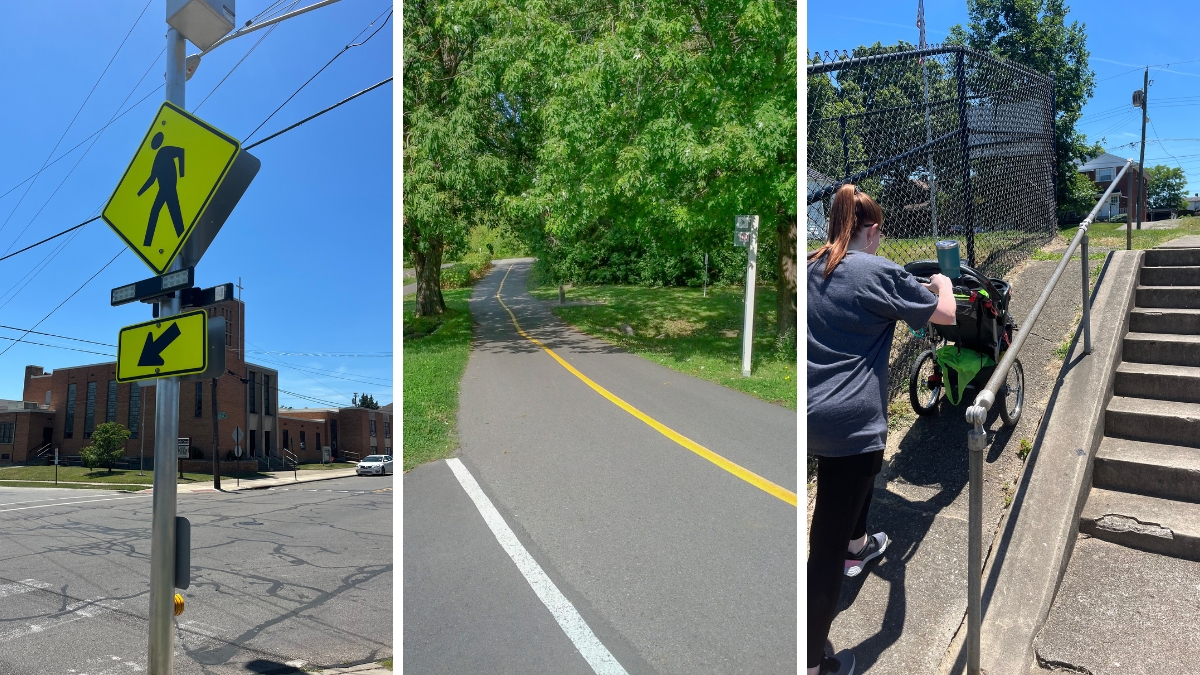
In 2022, WeTHRIVE! population health specialists began working on Active Transportation Plans with two WeTHRIVE! communities – Lincoln Heights and Mt. Healthy. This process involved collaboration between residents, elected officials, and administrators; Hamilton County Public Health; Hamilton County Planning + Development; the Ohio Department of Transportation (ODOT); the Ohio Department of Health; and Toole Design.
Today, Active Transportation Plans for both communities have been drafted and will soon be presented to village/city councils for approval. WeTHRIVE! teams in Lincoln Heights and Mt. Healthy have developed proposals for short-term demonstration projects based on Plan recommendations.
In today’s post, we’ll explore the idea of active transportation and how a plan is created.
What is active transportation?

Any time you go somewhere without using a car, that’s considered to be a form of active transportation. It’s often described as walking, biking, and rolling – with rolling referring to wheelchairs, strollers, scooters, skateboards, rollerblades, etc.
“We’re focused on everything that’s not car-driven,” says Luke Orednik, associate planner with Hamilton County Planning + Development (HCP+D). “And I really want to emphasize cars, because I think active transportation includes other transit, to an extent, such as public transportation.”
Why is active transportation important?
Not everyone has access to a car and some are unable to drive, so active transportation is key to ensuring that people can safely get where they need to go – work, school, grocery store, church, community center – without relying on an automobile.
Then there are the physical and mental health benefits associated with active transportation. When people can walk, bike, and roll to destinations, their daily physical activity increases. This can help reduce the risk of developing chronic diseases, such as heart disease, obesity, and diabetes. Physical activity is also linked to better sleep, less depression and anxiety, and overall quality of life.
“Having an active transportation plan is probably one of the best preventative health measures that a community can take,” Luke says.
Other benefits of active transportation include a boost in economic development and improved environmental quality.
What is an Active Transportation Plan?
An Active Transportation Plan (ATP) is a document that outlines strategies to enhance safe walking, biking, and rolling conditions in a community. Once a community has an ATP, they can use it when applying for grant funding to implement active transportation projects.
The planning process varies from community to community, but in general follows steps recommended in ODOT’s Active Transportation Plan Development Guide.
Here’s how it worked for Lincoln Heights and Mt. Healthy:
Form a team:
Ideally, you have a group that includes administration, elected officials, community stakeholders, and residents. Mt. Healthy and Lincoln Heights both have long-standing WeTHRIVE! teams that have been participating in the active transportation planning process.
At right, Mt. Healthy’s WeTHRIVE! team meets for a planning session.

Find out what’s already been done:
This involves gathering any existing plans and policies the city/village/township has that are related to active transportation. Examples include regional trail and transit plans, land use and development plans, and Safe Routes to School travel plans. Plans like these can help identify priorities, needs, or gaps that may be included in the ATP.
Get input from residents:
Mt. Healthy and Lincoln Heights held community engagement mapping activities to find out what’s important to residents.
For example, the Lincoln Heights team set up a table at a community event. Using an enlarged map of the village, they asked residents to point out destinations they often walk or bike to, road and sidewalk conditions on these routes, and barriers to walking and biking.

Later, the team attended another community event where they asked residents to prioritize recommendations based on the initial mapping activity and other information gathered during the planning process.
The Mt. Healthy team conducted similar community engagement mapping activities at the Tikkun Farm Free Market and with Tikkun Farm student volunteers.

Walk the community:

Both teams spent several hours completing walk audits – walking through the community, to and from common destinations, such as the grocery store, library, schools, and parks. As they walked (and pushed a stroller), they documented everything a person might encounter as they walk, bike, or roll to get places. Some team members carried maps and marked positive and negative conditions along the way. Others filled out walk audit worksheets.

Here are just a few examples of what the teams looked for:
- Sidewalks – are they free of cracks or raised sections? Are they continuous? Do they have curb cut ramps at street crossings?
- Crosswalks – are they marked? Are they ADA-compliant? Is there adequate time to cross?
- Bus stops – is there a place to sit? Is it covered in case of bad weather?
Develop and prioritize project recommendations:
After analyzing all the information obtained from community engagement, existing plans and policies, and walk audits, it’s time to develop recommendations for projects that will improve active transportation.
Professionals from Hamilton County Planning + Development and Toole Design provided assistance with this step. With their help, the teams discussed the recommendations and ranked them in terms of priority.
In some cases, additional community engagement activities are held so that residents can also provide feedback on the recommendations.

Compile an Active Transportation Plan document:

The end-product of the planning process is a comprehensive Active Transportation Plan, a document that outlines the team’s vision and goals, explains how the community participated in the process, reviews existing conditions, presents the priority projects, and provides potential funding sources.
ODOT has a template to help communities compile an Active Transportation Plan.
What’s next?
In September, WeTHRIVE! will present the Active Transportation Plans to Mt. Healthy City Council and Lincoln Heights Village Council for approval.
The Mt. Healthy and Lincoln Heights WeTHRIVE! teams are also working on demonstration projects, which are low-cost, temporary projects designed to show what future changes could look like and get community feedback.
We’ll report on these next steps and more, so stay tuned to our website and social media!
Come out to Lincoln Heights on Saturday, September 7, 2024, to participate in an active transportation demonstration project build – go here for more information and to sign up.
Stay up to date on all things WeTHRIVE! by subscribing to our stories! Just enter your email address below to get new posts sent right to your inbox.