
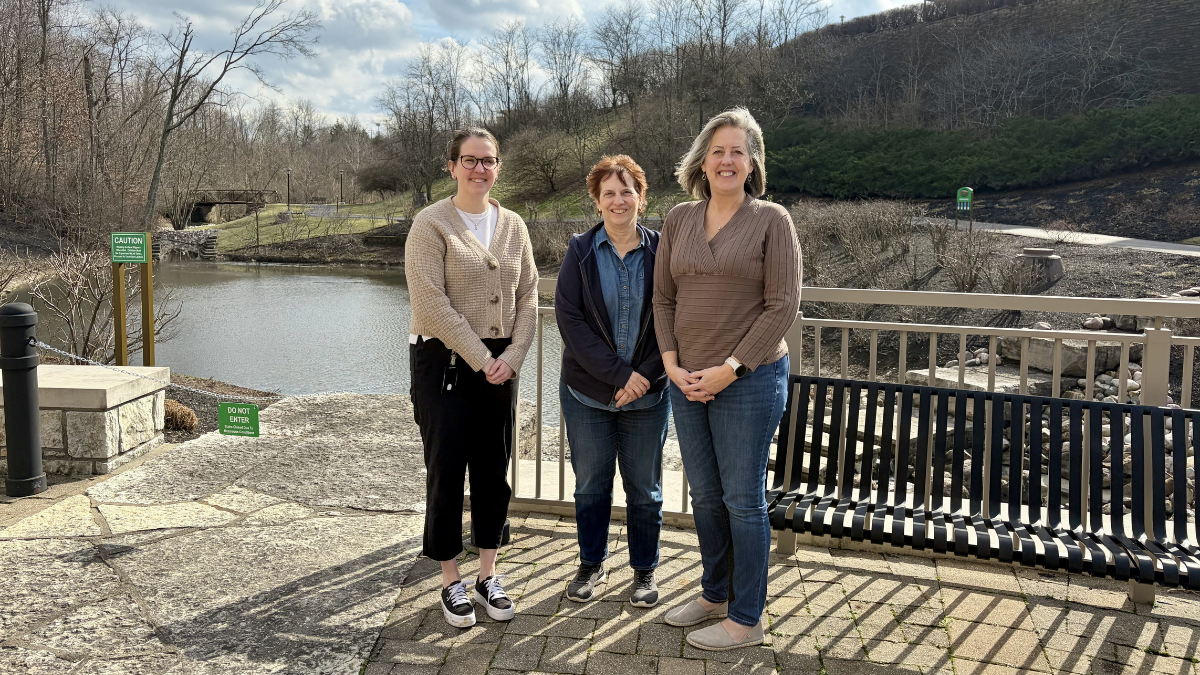
Anderson Township’s comprehensive plan includes preserving and protecting the natural and environmental resources found throughout the community. Members of the WeTHRIVE!/Comprehensive Plan Implementation Committee are on a mission to do this, one plant at a time, through the Anderson Township Native Plant Initiative.
What are native plants?
Native plants are varieties that are found naturally in a region. Since they’ve adapted to local conditions, these plants require little maintenance and no pesticides or fertilizer. They provide food and shelter for birds, pollinators, and other animals.
Going native in Anderson
Peg Fetter (top photo, right) came up with the idea of the Native Plant Initiative, which encourages people to grow native plants in their yards. An Anderson resident since 1991, she started “going native” in her own yard in 2021 after reading about the environmental benefits.
A few years later, Peg led the Creation Care team at St. Timothy’s Episcopal Church in Anderson in planting a native plant garden on church property.
Susan Wheatley (top photo, center) shares Peg’s concerns about the environment and joined her in creating the Native Plant Initiative. Susan grew up in Anderson, moved away, and has been back for 20+ years. She says her husband is the gardener in the family, but emphasizes that you don’t need a green thumb to plant native!
Sarah Donovan (top photo, left), assistant director of planning and zoning with Anderson Township, supported Peg and Susan throughout the process of developing the Native Plant Initiative.
What does native planting look like?
Peg used the evolution of St. Timothy’s pollinator garden (pictured below) to show township trustees what planting native could look like. They started with a grassy spot that had to be mowed and watered. A few months later, they had a native garden that thrives with little maintenance.


One yard at a time
Anderson Township has lots of greenspace where native plants can grow, Peg explains, “but we also have a ton of yards. What if residents planted native in their own yards? They would be changing their space to help the biodiversity, to help the birds as they migrate through, and to help bugs and everything that go from yard to yard.”
Planting native in your yard is the foundation of Homegrown National Park® (HNP), a program that inspired Peg and Susan.
HNP® was founded by Doug Tallamy, an entomologist, conservationist, and professor at the University of Delaware. He says the national parks aren’t enough to preserve the species we all need to survive. But by “extending national parks to our yards and communities,” we can restore habitats for the flora and fauna that are supposed to thrive in our region.
Mapping the initiative’s progress
The HNP® website includes a map that tracks where people all over the country are planting native. “The map allows everyone to see how much native planting is taking place in their area,” Susan explains. “We want to spread the word about this and encourage everyone to add themselves to the map. We’d like to see that number meaningfully increase every year.”
Planting one native plant, shrub, or tree is enough to get on the map. All it takes is setting up a free account and entering your location and what you’re planting.
“By leveraging the Homegrown National Park® movement, Anderson Township encourages residents to create wildlife habitats in their own yards and neighborhoods by focusing on native plants.”
–Dee Stone, Anderson Township Trustee
One plant at a time
Peg and Susan wanted to make the Native Plant Initiative as simple as possible. They decided to select a native plant of the year and encourage residents to plant it.
“We landed on doing one plant a year because we were worried it was going to be overwhelming for people,” Peg says. “Our picture was that in five years, people will have this nice little native plant garden.”
Last year’s native plant was the Black-eyed Susan. The 2026 native plant of the year is the Bluestar, which attracts native bees and hummingbirds. It’s also a host plant for certain caterpillars.
Components of a successful initiative
🌻 Plant of the year kick-off event
Last year, the team hosted an event to introduce the community to the Native Plant Initiative and promote the Black-eyed Susan as the native plant of the year. About 80 people attended. They learned about native plants from Scott Beuerlien, a horticulturist from the Cincinnati Zoo, and staff from Native Roots, which is sponsoring the Native Plant Initiative. This year’s kick-off event will be held on May 17 at the Heritage Center in Anderson.

🌻 Native beautification awards
Anderson’s annual beautification awards recognize home and commercial gardens. “In 2025, we added a category for the use of native and pollinator-friendly plants,” Sarah says. Showing people what native planting looks like in someone’s yard helps promote the initiative and gets people excited about it.


The winner of the 2025 Anderson Township Beautification Awards for the pollinator category.
🌻 Local sponsor
Peg and Susan took their idea to several garden centers/landscapers in the township. Native Roots ended up sponsoring the initiative. They help promote the initiative and provide education about native planting and the native plant of the year.
🌻 Clarifying native vs nuisance
You never know how planting native might be interpreted. Will people let their yards go and claim they’re just going native? Sarah appreciated working with the team on this issue. “I was able to show Susan and Peg photos of nuisance properties that we’ve had and say, I know what your vision is and I know you want native gardens, so how do I prevent this?” The answer ended up being a Lawn Naturalization Policy.
Native plant featured on township logo

Anderson Township has embraced the idea of planting native for the good of the environment. They even added it to their logo.
The logo previously incorporated the image of a tree. Now, the tree will be replaced by the native plant of the year!
Moving forward
The community’s response to the Native Plant Initiative has been positive. More residents are joining Peg and Susan on the initiative’s planning team. And a young Scout is planting small native gardens throughout the community as her Eagle Scout project.
“Anyone can participate, just by planting one seed or seedling every year,” Peg says. Whether you’re planting in your yard or a container, you’re helping the environment when you go native!